

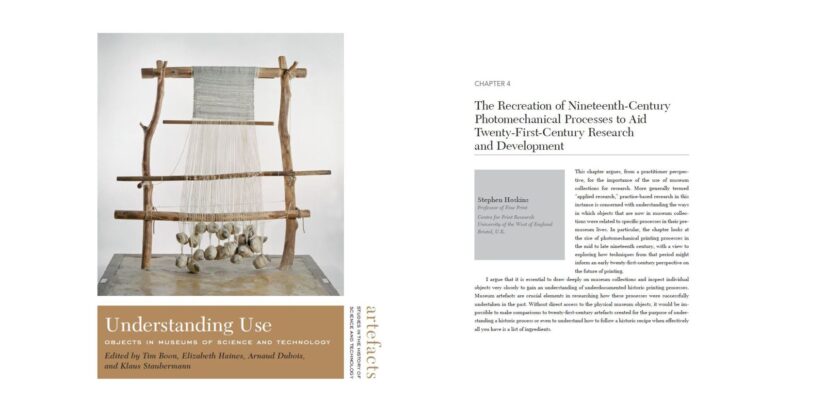
Professor Stephen Hoskins has published the chapter The recreation of 19th century photomechanical processes to aid 21st century research and development in Understanding Use: Objects in Museums of Science and Technology, Smithsonian Scholarly Press.
Edited by Tim Boon, Elizabeth Haines, Arnaud Dubois, and Klaus Staubermann, Understanding Use proposes a way of thinking and of developing practice around four varieties of use of objects in science and technology museums: first, the ways that machines, instruments, and equipment were used in their pre-museum “lives” (which provides the most frequent reason for their acquisition); second, the ways in which research can re-create usage history of obsolete objects; third, the ways that museum staff have employed objects in their “museum lives” as members of collections; and last, the possibility of reconceptualizing museum visitors as users of collections and displays. Thinking of museum objects in these ways—that is, in terms of use—could constitute a coherent approach to museum work that enriches the wider purpose of science and technology museums.
Professor Hoskins argues, from a practitioner perspective, for the importance of the use of museum collections for research. More generally termed “applied research,” practice-based research in this instance is concerned with understanding the ways in which objects that are now in museum collections were related to specific processes in their pre-museum lives.
In particular, his chapter looks at the rise of photomechanical printing processes in the mid to late nineteenth century, with a view to
exploring how techniques from that period might inform an early twenty-first-century perspective on the future of printing. He argues that it is essential to draw deeply on museum collections and inspect individual objects very closely to gain an understanding of under documented historic printing processes. Museum artefacts are crucial elements in researching how these processes were successfully undertaken in the past. Without direct access to the physical museum objects, it would be impossible to make comparisons to twenty-first- century artefacts created for the purpose of understanding a historic process or even to understand how to follow a historic recipe when effectively all you have is a list of ingredients.

