


Retrospective: ‘Bound in Place’, An exploration of print, bookbinding, and how materials tell stories about a place.
Brian Norman Printmaker/Bookbinder, UWE Alumni: MA Fine Art Printmaking
UWE Reel Cases showcase, Bower Ashton, October to December 2025. Presented by the Centre for Print Research and Bristol Materials Network.
I began my master’s degree with the question, of who am I, as a creative entity? I found the beginnings of understanding in those quiet reflective moments while walking and through intense exploration of processes, materials, seeking links between these interconnected aspects of my creativity. Søyland (2021) poses that we make sense of knowledge through our embodied mind in a process that is framed by ‘embodied sense making’. This conceptual framework connects thinking with our sensory interaction with the environment to make sense of it. My practice mirrors this requiring bodily engagement, focus and a deep connection with the materials being used.
Bound in Place as a project began within my master’s degree with Reverence [Fig.1], evolving into three places of focus that are very different environments. Although each was engaged through a particular lens, they represent journeys interlinked by a common conceptualisation. Seaton Beach was about ‘arrival’ to a place, Dartmoor about journeying ‘within a place’, and Holyford Woods about being ‘present’ in a place of ritual. All were articulated through book form, ink, thread and site-specific material thinking, to find an embodied thread between Artist – Place – Experience – Material – Audience. Book artifacts, like memory, break down a narrative into a series of moments. How we engage with those moments shapes the story the book object tells, transcending the content. The Reel Case exhibition spaces, positioned as self-contained places across two buildings on Bower Ashton Campus, and by suspending fragmented works within each space, frames this show as a series of moments. To fully experience the exhibition required close examination and a journey between each reel case.
New Materialism, in the context of the book form, examines how the materials and processes involved actively shape creation and meaning. This perspective emphasizes the agency of materials and objects, suggesting that they are not passive elements but active actors in the bookbinding process (Carlin, 2021). Bound in Place was intended to engage the material nature of the bound object and express that in the way that I engaged with each locality as an experience.

Collagraph, etching and site-specific organic material, on 300gsm cotton paper.
(Deconstructed bound structure and traditional linen thread. Paper treatment: eco-printing boiled book technique utilising site-specific organic material. Alum and silver nitrate, chemicals used to bond dyes to a substrate)
Reverence [Fig.1] explores this theory through the serendipitous discovery of an undocumented memorial tree in Holyford Woodland, in East Devon. When you discover the Oak tree, it visually dominates the woodland being one of the early denizens of this place, standing bold amongst Ash and Hazel. Hints of colour and hanging items invite you to look closer, engage with and reflect on, the stories that the items might tell. My research failed to find a formal record of this tree, but the District Council Countryside Team claim this to be one of the oldest natural woodlands in England with it being there over 400 years (Wild East Devon, 2026). Oak trees have a long history of being a religious and spiritual focus of ritual. In the hope they will ensure a person, or an event is not forgotten. As slow growing, long-lived trees they enhance the idea that the memory they represent will endure (English Heritage, 2026). The act of memorial changes the nature of the tree as an entity.
Viewing the work from a distance, a tree form is seen, but as the work is engaged with, layers of meaning are discovered in material sourced from the site and the icons placed around the tree. The ‘Theorem of Trinamics’ frames this as a dynamic of two things, that when combined, give
birth to a third (Pistoletto, 2012). Therefore, by responding creatively to this tree ‘object’, transformed already by the act of ritual, it becomes the third entity, through the agency of creative interpretation. The memorial tree holds the memory, but the objects themselves tell the story, acting as markers (Bowman, 2021).
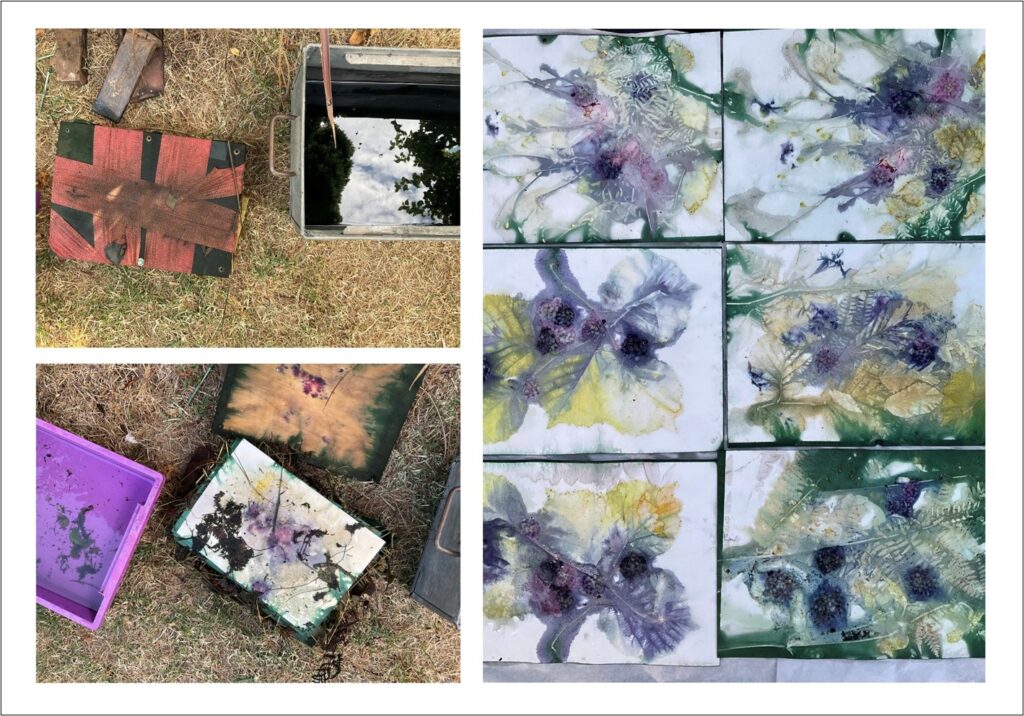
Organic matter taken from the different sites, creates an eco-dyed foundation layer, in the way that ground flora and organic litter forms a foundation for the site. Eco dyeing is a process of creating unique printed matter by layering organic materials with paper or fabric. Heat and moisture forces pigments from the materials to bond with the substrate. The nature of ‘boiled book’ eco-printing is fraught with risk and outcomes are shaped by serendipity to a degree, but mostly by an intuitive embodied understanding of the materials used. The materials and process have their own agency that is determined by many factors: plant type, time of year, composition of the substrate used, how the package is bound and by what, if mordants are used, when and how they are applied, if and what types of pigments are added to the bath and finally, how long the package is boiled [Fig.2]. Similar in spirit to Soil Chromatography, a photographic process used to visualise the chemical, physical and biological characteristics of site-specific samples, this process allowed me to put something from the site into the artifacts creating a metaphysical and a physical link to the site in the work. This engaged with a process of oriented tacit knowledge, described by Toon (2012) as a “product of thinking and action, and as a process during action,” linking understanding to sensory feedback received from materials and experience. This instinctive, responsive way of working is reflected in my printmaking practice, where the next step in the development of an image is a response to where the image stands. I often have greater clarity about how I want the outcome to feel, rather than knowing how it is going to look.
Overprinting the eco-dyed images using collagraphy, a textual collage-based printing plate, captures the organic, tactile nature of tree bark to represent the tree form. Accompanied by etched icons of some of the ritual offerings, displayed as two vertical diptychs. The installation was made up from twenty-four individual printed pages, from a deconstructed book, exploring experience as a narrative, a series of interconnected sensory moments reconstructed by our consciousness. The thread acts as a metaphor for the connections between moments, running through the case like tree roots.
The book form is a culturally familiar object containing ideas and knowledge. From a materialist point of view, books themselves can be made from leather, paper, board and thread, thus are made from the fabric of my chosen places of focus, both natural and human left. Bates (2025) describes leather as embodying resilience, making it a powerful symbol of endurance. Being the ‘skin of a book’, it serves as a metaphor for life, enduring hardships and showing marks of experience and time. This acts as a metaphor for the sacred tree, a temple marking loss and remembering these trials. Alongside this, the book form contains moments of time and constructs them into narratives to share stories and worlds.
Two further works developed from interacting with this ritual tree are, Mother Tree and Icons.
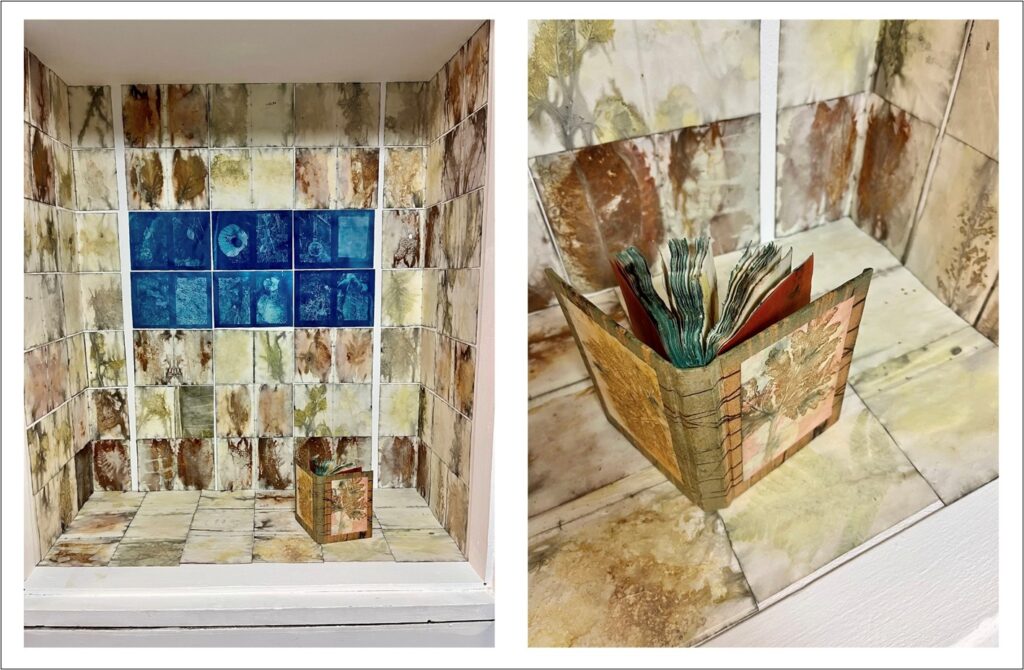
Cyanotype and eco-dyed site-specific organic survey on 90gsm Khadi cotton paper.
(Constructed and deconstructed bound structure and traditional linen thread. Paper treatment: eco-printing boiled book technique utilising site-specific organic material. Alum and silver nitrate mordants)
Icons [Fig.3] (Memorial icons left at the feet of Dagda) is focused specifically on the icons and materials present at the site and explores what Bell and Vachhani (2019) describe as the reciprocal interaction of human and nonhuman agents. They pose that material objects that are assumed to be passive and inert, are changed by the human-nonhuman interaction. At the heart of this reel case installation sits the icons in the same way the objects sit at the heart of the sacred tree. Material Engagement Theory conceptualises this; suggesting that “tasks are brought forth through the relational engagement of brains, bodies, and things” (Malafouris , 2004, p.58).This sits at the heart of my practice, a meeting of mind and matter as a transactional process, but I continue explore to what degree agency can be accredited.

Cyanotype on 90gsm Khadi recycled cotton paper
(Deconstructed bound structure and traditional linen thread)
Mother tree [Fig.4] (Holding court in the whispering chatter of her abode, the ‘mother tree’ nurtures her woodland denizens) is representable of my interaction with this sacred tree. In the process of exploring and engaging with the tree as an entity, I climbed, observed, and circled. This work captures the movement of seeing all the facets of this object in its environment. It allowed me to weave in photo-sketches, to stitch together the observed three dimensions, held within two.
The second location of study followed the same methodology, this time in exploring my local beach in Seaton. Seaton white cliffs and shingle [Fig.5] (First the ocean calls me, salted air and stones shimmering beneath clear waters, shingle beneath my feet. Then white cliffs, catching the light). It explores a much simpler experience of arriving at a common shingle beach, like many on the South Coast, but the eye being drawn instinctively, to the white chalk cliffs of Beer, seemingly at odds to the surrounding landscape, particular to the local geology of East Devon. Extending from the shoulders of surrounding mudstone, shingle and human detritus, this headland reflects its glory in the ocean.
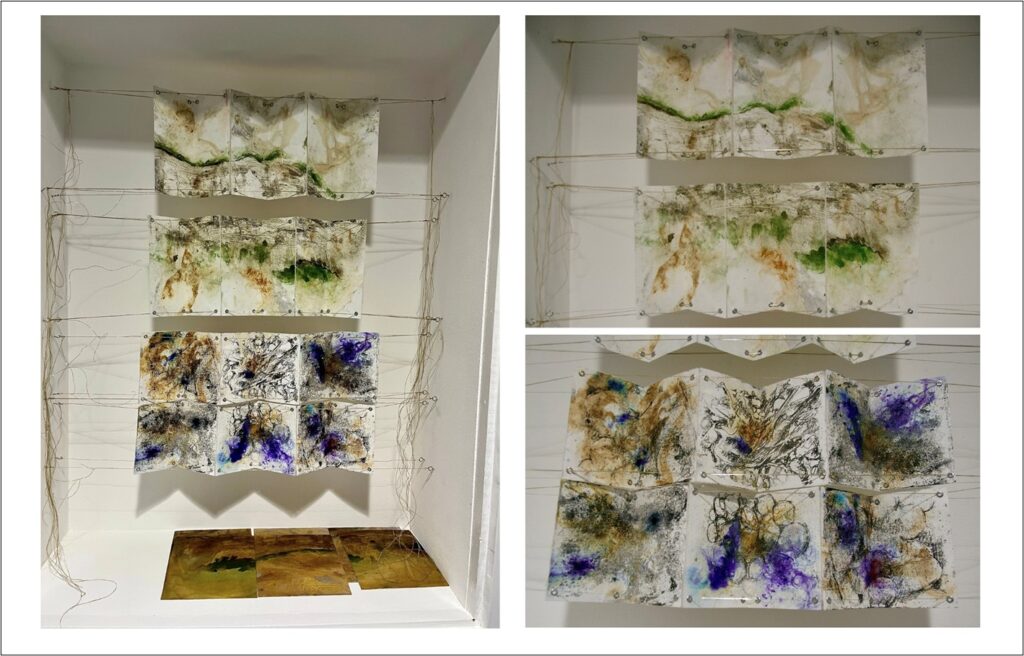
Collagraph and foil lithography on pre-treated 300gsm BFK Rives paper.
(Bound structure is supported by Japanese tissue utilising binding repair techniques used to support fragile structures. Paper pre-treatment: eco-printed steamed paper technique utilising beach found organic material and leather dye pigment. Processed in seawater)
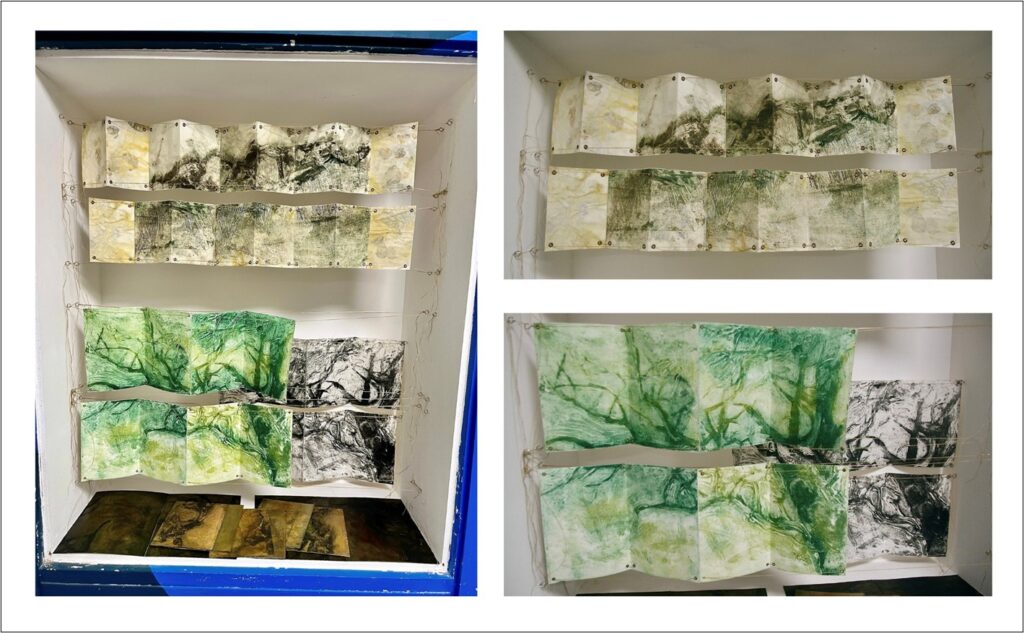
Collagraph on 300gsm BFK Rives paper.
(The bound structure is supported by archival repair tape using techniques to repair and support fragile pages. Paper treatment: Pre-soaked in moorland water)
My third location of study was Dartmoor, a seemingly wild primal place that is layered in hidden and lost history. I wanted to explore it as a place of extremes. Of high, wind blasted and scoured rocks, and remnants of past human occupation and endeavours. Represented through the works of both Exposed bones of the earth [Fig.7] (Exposed bones of the earth reaching for granite skies. Here stands the gateway to the unseen world) and An incessant wind [Fig.6] (An incessant wind stirs the grasses nodding at tumbled stone reaves under wild skies). Alternatively, quiet low places where ancient woodland co-exist alongside the ever-present actions of water, grow and soften the senses are responded to In forests of mist and moss [Fig.6] (Wind twisted trees bearded by moss. Earthy green and silhouetted darkness against the moorland sky). In dialogue to this place, images are broken, layered and connected through the land-based minerals and grasses.

Collagraph on pre-treated 300gsm BFK Rives paper
(Bound structure is supported by Japanese tissue utilising binding repair techniques used to support fragile structures. Paper pre-treatment: eco-printed steamed paper technique utilising site-specific organic material and moorland water)
Bound in place as an exhibition represents an important moment in the development of my artistic practice. Positively challenged by this dispersed show space, it has deepened my understanding of the positioning of my practice in the context of public engagement.
Brian Norman
Insta: @bazpress
References
Bell, E. and Vachhani, S. (2019) Relational Encounters and Vital Materiality in the Practice of Craft Work. Organization Studies [online]. 41/5, pp.681-701 [Accessed 18/04/2026].
Bowman M. (2021) Trees, Benches and Contemporary Commemoration: When the Ordinary Becomes Extraordinary, Journal for the Study of Religious Experience, 7/3, Available from https://rerc-journal.tsd.ac.uk/index.php/religiousexp/article/view/105 [Accessed 18/04/2026].
Carlin, B. (2022) Bindings, boundaries, and cuts: relating agency and ontology in photobook encounters, Doctoral dissertation [online]. PDH, Newcastle University. Available from http://theses.ncl.ac.uk/jspui/handle/10443/5615 [Accessed 11/04/2026].
English Heritage (2026) Gardens and Landscapes: Commemorative Trees. Available from: https://www.english-heritage.org.uk/learn/conservation/gardens-and-landscapes/commemorative-trees/ [Accessed 11/04/2026]
Malafouris, L. (2004). The cognitive basis of material engagement: Where brain, body and culture conflate. In E. DeMarrais, C. Gosden, & C. Renfrew (Eds.), Rethinking materiality: The engagement of mind with the material world (pp. 53–62). Cambridge: McDonald Institute for Archaeological Research. [Accessed 18/04/2026].
Pistoletto, M. (2012) Hominitheism and Demopraxy, Hominitheism and Demopraxy Manifesto.
Available from: https://www.pistoletto.it/eng/testi/hominitheism-and-demopraxy.pdf [Accessed 11/04/2026]
Søyland, L. (2021). Grasping materialities: Making sense through explorative touch interactions with materials and digital technologies, Doctoral Dissertation [online]. PHD, University of South-Eastern Norway. Available from https://www.researchgate.net/publication/365028390_Grasping_materialities_Making_sense_through_explorative_touch_interactions_with_materials_and_digital_technologies [Accessed 11/04/2026]
Tanner Bates (2025) Leather’s Role in Cultural Traditions and Symbolic Meaning, Tanner Bates Available from: https://www.tannerbates.co.uk/blogs/knowledge-base/leather-s-role-in-cultural-traditions-and-symbolic-meaning [Accessed 18/04/2026]
Toom, A. (2012) Considering the Artistry and Epistemology of Tacit Knowledge and Knowing [Online]. Educational Theory. Volume 62/10.1111/edth.12001. [Accessed 18/04/2026]
Wild East Devon (2026) Holyford Woods Local Nature Reserve. Available from: https://wildeastdevon.co.uk/nature-reserves/holyford-woods-local-nature-reserve/#:~:text=The%20woods%20also%20feature:%20*%20A%20sunken,close%20control%20and%20clean%20up%20after%20them [Accessed 11/04/2026]

