Stephen Hoskins
Stephen is Professor of Fine Print and Founder of the Centre for Print Research.
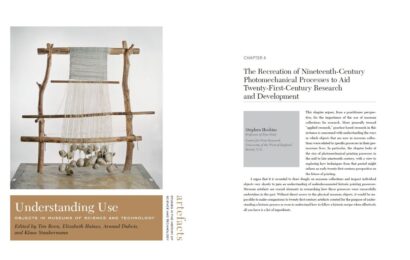
Apart from being a practicing printmaker, Steven’s primary areas of research are; traditional printmaking technologies and materials, the potential of 3D printing and related digital technologies for the arts, plus the tactile surface of the printed artefact and its consequences for digital technology. His latest book, Ink for Printmakers, is due to be published by Herbert Press, Bloomsbury in 2024. Inks have remained a fundamental aspect of the printing process for thousands of years. In this comprehensive and accessible guide, Stephen Hoskins and Michael Craine trace the development of inks from ancient China, through the Middle Ages and the industrial revolution, to the digital age. This books offers detailed guidance to the inks used for various processes from etching and relief-printing to lithography and screenprinting, and also includes a list of suppliers and full biography. By exploring the technical make-up and manufacturing process of many different types of ink, this book offers practical information to all levels of printmaking from specialist to amateur. Stephen has published three other books: Water based Screenprinting, 3D Printing for Artists, Designers and Makers and Inks. His most recent chapter is The recreation of 19th century photomechanical processes to aid 21st century research and development due to be published in 2024 in Understanding Use published by Smithsonian Scholarly Press. He has over 40 peer reviewed papers and articles, and has 3 patents: ‘Novel methods of water based screenprinted ceramic transfers’; ‘Printer with substrate registration means’ and ‘A Method of 3D Printing Ceramics’.
Area Of Expertise
Stephen’s philosophy for research at the Centre for Print Research (CFPR) has always been based on the production of the physical artefact, primarily predicated in print. Central to this ethos is the relationship between technology and making from a practitioner perspective.
This places Stephen and the CFPR in an unusual position of understanding digital and new media technologies but always relating them to physical output and creativity. His research focus is on the close relationship that exists between technology, ideas and craft skills as understood in a visual environment.
Due to his belief in interdisciplinary collaboration Stephen has an outstanding track record of working with industry. Project partners include, Hewlett Packard, Denby Pottery, Burleigh Pottery, Renishaw, St Cuthberts Mill, John Purcell Paper, Cranfield Colours, Canon, Roland DG, Viridis 3D and Dycem amongst many others. In recognition of his interdisciplinary understanding Stephen held a Hewlett Packard sponsored Professorial Chair from 2004 to 2014.
Research Topics/Interests
printmaking; 3D print; tactile surface; ink
Collaborations
Hewlett Packard; Renishaw PLC; Burleigh Pottery; Denby Pottery; Dycem
Teaching
Stephen has supervised over 14 PhD and MPhil students through to completion as Director of Studies and has been an external examiner for the Universities of the Arts, Brighton, Leeds, Southampton and Ulster, Staffordshire University, Camberwell School of Art and the London Institute.